Construction Site Safety in Ecuador: Risks, Regulations and Prevention

In this article
- The main risks on a construction site
- Construction site safety regulations in Ecuador (2026)
- What the new regulation requires in practice
- Who is responsible: owner, main contractor, contractors and site supervision
- On-site prevention, step by step
- Common mistakes on site
- Practical safety checklist for your construction site
The basis of construction site safety in Ecuador changed in September 2025: the Ministerio del Trabajo (Ministry of Labor) issued a new sector regulation that replaces the 2008 one and requires a safety study from the design stage, a program approved before work begins, and work permits for high-risk tasks. In this guide I summarize the main on-site risks, the regulations in force in 2026, and a practical prevention plan for builders, contractors and project owners.
The main risks on a construction site
Every project is different, but serious accidents keep happening in the same situations. These are the risks worth prioritizing in your risk matrix:
| Risk | Where it appears | Key control |
|---|---|---|
| Falls from height | Slabs, edges, scaffolding, roofs, ladders and stairs | Guardrails and nets first; harness and lifeline when collective protection is not enough |
| Collapses in excavations and trenches | Sewer systems, foundations, water networks | Sloping or shoring depending on the soil, stockpiles kept away from the edge, safe access |
| Struck-by and caught-in hazards | Load lifting, formwork, demolition | Exclusion zones, a signal person, nobody under suspended loads |
| Machinery and vehicles | Earthmoving, dump trucks, rollers | Qualified operators, reversing alarm, marked-off operating radius |
| Electrical contact | Overhead lines, temporary panels, tools | Safe clearance distances, de-energize and lock out, grounding |
| Manual handling of loads | Cement, blocks, rebar | Mechanical aids, shared lifting, breaks |
| Heat and solar radiation | Road works and open-air sites, especially in the coastal region and the Amazon | Drinking water available, shade for breaks, task rotation, skin and eye protection |
| Dust and noise | Cutting, demolition, crushing, compaction | Wetting down, respiratory and hearing protection based on measurements |
| Traffic on road works | Rehabilitation and maintenance of roads open to traffic | Traffic management plan, advance signage, night-time lighting, traffic control staff |
Construction site safety regulations in Ecuador (2026)
Many documents still cite repealed regulations. This is the framework in force as of October 2026.
1. The sector regulation for construction (MDT-2025-122)
The core regulation is Acuerdo Ministerial MDT-2025-122 (Ministerial Agreement MDT-2025-122), signed on September 8, 2025, which issues the Reglamento de seguridad en el trabajo y prevención de riesgos laborales para la construcción y obras públicas y privadas (Occupational Safety and Risk Prevention Regulation for Construction and Public and Private Works). Its repealing provision revokes Ministerial Agreement 00174, published in Registro Oficial (Official Gazette) No. 249 on January 10, 2008, which was the sector's reference for years. It came into force upon publication in the Registro Oficial.
It applies to all public and private works, including modification, repair, refurbishment and maintenance work: that also covers remodeling a commercial unit or maintaining a road.
2. The general Occupational Health and Safety Regulation (Executive Decree 255)
The construction regulation builds on the Reglamento de Seguridad y Salud en el Trabajo (Occupational Health and Safety Regulation) issued by Executive Decree 255 (Decreto Ejecutivo 255) of May 2, 2024, which replaced the old Executive Decree 2393 of 1986 as the general regulation. One important detail: Decree 255 itself provided that, until the Ministerio del Trabajo issued the technical safety and hygiene rules, articles 21 to 184 of Decree 2393 would remain in force, except articles 64, 65 and 67. Those technical rules were later published as Annex 3 of Ministerial Agreement MDT-2024-196, so if your procedures are still based on Decree 2393, it is worth updating them (I explain this in the guide to occupational health and safety (OHS) obligations). For enforcement, the Ministry also applies Ministerial Agreement MDT-2024-196 on compliance with and control of OHS obligations. I cover the general obligations that apply to any company in the guide to Occupational Health and Safety in Ecuador.
3. IESS Occupational Risk Insurance (C.D. 513)
Resolución C.D. 513 contains the Reglamento del Seguro General de Riesgos del Trabajo (Regulation of the General Occupational Risk Insurance) of the IESS (Instituto Ecuatoriano de Seguridad Social, Ecuador's social security institute) (amended in 2025 by Resolución C.D. 692 with regard to how an accident is classified). The one thing you must not forget is the notice: according to the IESS, the employer must file the workplace accident notice online within 10 business days of the date of the accident.
4. The Andean Instrument and technical standards
Ecuador also applies Andean Community Decision 584 (Instrumento Andino de Seguridad y Salud en el Trabajo, the Andean Instrument on Occupational Health and Safety) and its implementing regulation, Resolution 957. For technical matters such as signage and protective equipment, the regulation refers to INEN standards (issued by Ecuador's national standards body) and, where none exist, to international standards.
What the new regulation requires in practice
Safety study and safety program
The regulation distinguishes between two documents. The occupational safety and risk prevention study (estudio de seguridad en el trabajo y prevención de riesgos laborales) is prepared during the design and planning phase by a safety technician (técnico de seguridad e higiene del trabajo) and includes a budget for the preventive measures. Then each employer involved (main contractor, contractors, subcontractors and suppliers) prepares a safety program based on its risk matrix by job position, with measures, deadlines and responsible persons; the program must be in writing, approved by the employer before work begins, communicated to the workers and kept on site.
On top of this comes the site incident log (registro de incidencias), physical or digital, with numbered pages, which must be kept on site and is a binding document for the purpose of fines or penalties.
Safety technician
Because construction is classified as a high-risk activity, every company in the sector must appoint a safety technician, even with 1 to 9 workers; from 200 workers upward, one more technician must be added for every additional 100. The technician must hold a bachelor's or postgraduate degree (título de tercer o cuarto nivel) in OHS, registered with the higher education regulatory authority, and must work in person on site.
Competency-based certification
The regulation requires competency-based certification in occupational risk prevention, issued by accredited Organismos Evaluadores de la Conformidad (conformity assessment bodies), for everyone working on the project, from designers and resident engineers to site foremen (maestros mayores) and workers. In addition, there is specific certification for deep excavations, operating earthmoving machinery and lifting equipment, erecting scaffolding and structures, and welding; motor vehicle operators in these activities need a Type G professional license (licencia profesional tipo G). Employers were given 18 months from the signing of the agreement to have certified technical personnel, that is, until early March 2027. If you hire contractors or tender works, start asking for these certifications now.
Work permits for special work
Special work, including hot work, work at height, electrical work, and work in confined and underground spaces, requires a specific procedure and a work permit issued by the employer through the safety technician. The permit's risk assessment is carried out on site and signed by the safety technician, the supervisor and every worker involved; the permit must be opened and closed every day, becomes invalid if conditions or the work crew change, and cannot be renewed: a new one must be issued.
Who is responsible: owner, main contractor, contractors and site supervision
Safety cannot be outsourced. When two or more employers work simultaneously on a site, they are jointly and severally liable for applying prevention and protection measures. The regulation assigns the roles as follows:
- Owner: hires parties that comply with safety regulations and commissions the safety study.
- Designers and planners: build prevention in from the design stage and include a safety line item in the budget.
- Main contractor: builds in accordance with the safety study, implements its program through the safety technician and monitors contractors and subcontractors.
- Contractors and subcontractors: each implements its own safety program.
- Site supervision (fiscalización): verifies compliance with the study, the program and the regulations; failure to do so is grounds for penalties.
- Resident engineers, supervisors and site foreman (maestro mayor): take part in prevention and report accidents and incidents to the safety technician.
In addition, employers sharing a site must coordinate in writing and include safety requirements in their contracts, purchases and rentals. For example, if you rent a backhoe with an operator, the contract should require the operator's license and certification and up-to-date equipment maintenance. These clauses are part of good construction project management: an accident also means delays and cost overruns.
On-site prevention, step by step
1. Plan before mobilizing
Before mobilizing machinery, review the safety study, the schedule and the interfaces between contractors, and define access routes, storage areas and the assembly point. The employer must have emergency and contingency plans, emergency brigades or, if the number of workers does not allow it, an emergency coordinator, and must hold drills at least once a year.
2. A living risk matrix
The risk matrix is not an annex to be filed away. Hazard identification and risk assessment must be updated immediately whenever there are accidents, schedule changes, or new contractors, methods, materials or equipment, and controls follow the hierarchy: elimination, substitution, engineering controls, administrative controls and, last of all, PPE.
3. Permits for work at height, excavations and hot work
- Work at height: work above 1.80 meters is considered work at height; collective protection (guardrails, nets, toe boards) is required and, when that is not enough, a fall arrest system with a full-body harness, anchorage and connector. Work at height must stop during heavy rain, electrical storms or strong winds.
- Excavations: the regulation requires soil analysis and identification of underground utilities before digging, shoring or retaining structures on unstable slopes without exceeding 1.50 meters of depth unprotected, access points at intervals of no more than 12 meters, and a ban on vehicles and loads closer to the edge than the depth of the excavation. The excavation must be inspected every day and after rain or vibrations.
- Hot work: remove flammable materials to at least 10 meters away, keep working fire extinguishers on hand and assign a fire watch.
4. Induction and daily safety talks
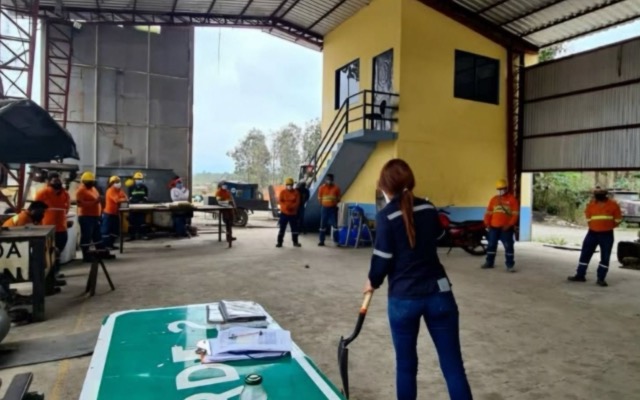
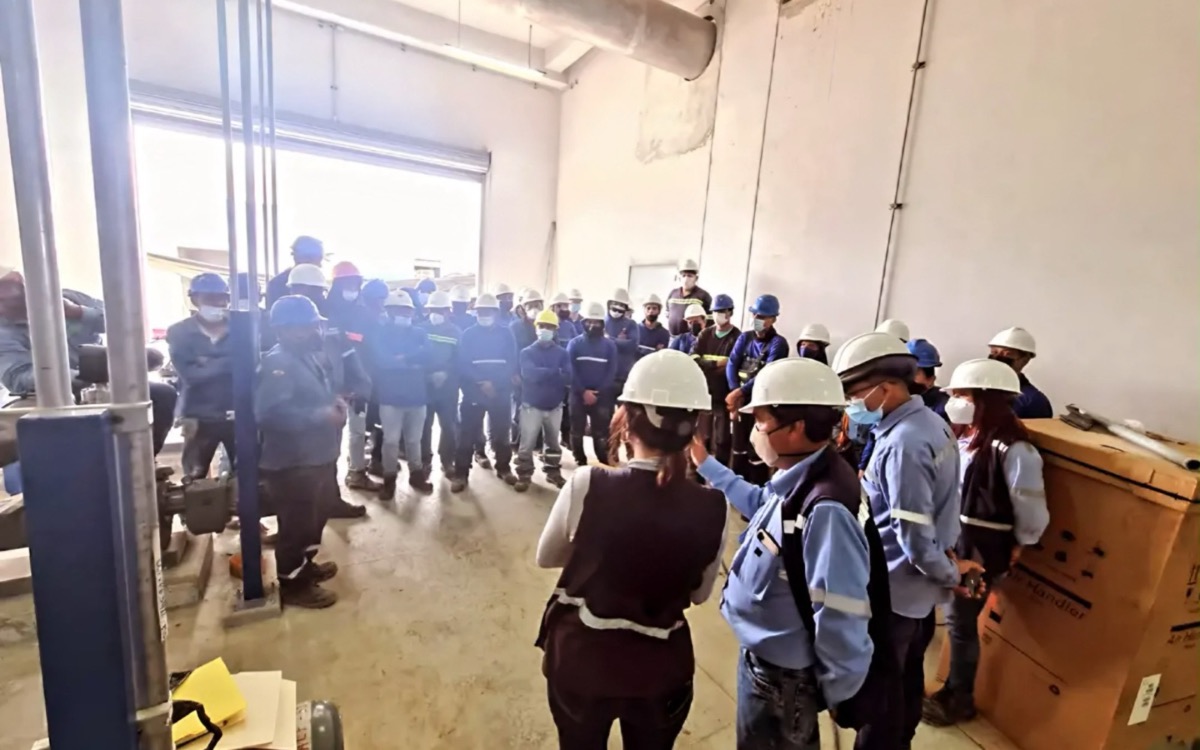
The regulation requires initial theoretical and practical training, in a language the worker understands, with physical or digital evidence, and meetings before starting any task covering the scope of the work, the hazards and the control measures, for all workers, including contractors. On site, this is what is known as the site induction and the daily toolbox talk. My recommendation: keep it specific (today's task and today's risk), have the supervisor of that work area deliver it, and record it with signatures and a photograph.
5. PPE and collective protection
PPE and work clothing are provided at no cost to the worker and must comply with national or international technical standards. Everyone on site must wear a certified safety helmet; for work at height, with a chin strap. PPE is the last line of defense: a guardrail protects everyone, all the time.
6. Signage and traffic management on road works
During the rehabilitation and paving of the Puente Negro – Vainillo road, I worked on environmental and safety management in coordination with government agencies, BDE (Banco de Desarrollo del Ecuador, Ecuador's public development bank) and the IDB (Inter-American Development Bank). With traffic still flowing, the hardest risk to control usually comes from outside: vehicles that do not slow down, machinery reversing and pedestrians crossing the work area. The regulation has specific provisions on this:
- Plan the work around three principles: maximum protection for workers, maximum protection for the public and minimum inconvenience to the public.
- Put all necessary signs in place before opening a detour or starting any work that poses a risk, light them at night, inspect them daily and remove them once they are no longer needed.
- Using stones, sticks or logs as road closure warnings is prohibited.
- Earthmoving machines must have an audible reversing alarm, nobody may stay within their operating radius, and dump trucks need a signal person when reversing. Sleeping or eating in the shade of these machines is also prohibited: set up a shaded rest area.
On urban sites, the regulation also requires a perimeter enclosure at least 2 meters high, marked pedestrian walkways and a protective canopy wherever there is a risk of objects falling on pedestrians.
7. Supervision and inspections
Schedule daily inspections of the work area and a more thorough weekly one with the resident engineer. Machines must be inspected daily before each shift (brakes, steering, lights, tires, alarms, among others), and the employer must keep a record of unsafe acts and conditions with the measures taken. Workers have the right to stop work in the face of imminent danger; make sure they know it and that nobody is penalized for using it.
8. Investigate accidents and incidents
The employer must investigate incidents, accidents and occupational diseases to identify their causes and take corrective action, and must maintain a recording and notification system. Investigate near misses too, and look for causes in planning, methods and supervision, not just in worker error.
9. Don't forget the environmental side
The regulation requires main contractors and contractors to manage construction waste and comply with municipal ordinances and environmental legislation, and provides for the labor inspector to notify the environmental authority if they find non-compliance. Since the merger ordered by Executive Decree 94 of 2025, the national environmental authority is the Ministerio de Ambiente y Energía (Ministry of Environment and Energy). If your project requires an Environmental Management Plan (Plan de Manejo Ambiental), coordinate both areas from the start.
Common mistakes on site
- Still citing Agreement 174. Procedures and contracts that rely on a repealed regulation come across as careless during an inspection.
- Not budgeting for safety. The safety line item must be included in the project budget; if it is not, it is the first thing to be cut.
- Delegating everything to the subcontractor. Liability is joint and several: if the subcontractor fails, the main contractor is also liable.
- Permits signed in the office. A permit without an on-site assessment serves no purpose and does not comply with the regulation.
- Improvised signage on roads. Too few cones, no night-time lighting, or signs placed after work has already started.
Practical safety checklist for your construction site
All of this is easier within a management system: the ISO 45001 standard helps organize planning, operational controls and incident investigation, and it fits well with Ecuadorian regulations. If you need support with the safety study and program, contractor documentation or site supervision, take a look at my ISO management systems and OHS services or write to me directly.
Frequently asked questions
Is Ministerial Agreement 174 of 2008 still in force for construction?
No. Ministerial Agreement (Acuerdo Ministerial) MDT-2025-122, signed on September 8, 2025, expressly repealed Ministerial Agreement 00174 and issued the new Reglamento de seguridad en el trabajo y prevención de riesgos laborales para la construcción y obras públicas y privadas (Occupational Safety and Risk Prevention Regulation for Construction and Public and Private Works), in force since its publication in the Registro Oficial (Official Gazette).
From what height is work on a construction site considered work at height?
The construction regulation defines work at height as work carried out more than 1.80 meters above ground level. Above that height, collective protection and a personal fall arrest system with a full-body harness are required and, because it is a special work activity, a work permit issued through the safety technician (técnico de seguridad e higiene del trabajo).
Does a small construction project also need a safety technician?
Yes. Because construction is classified as a high-risk activity, the regulation requires even micro-enterprises with 1 to 9 workers to appoint a safety technician (técnico de seguridad e higiene del trabajo). Companies with 200 or more workers must add one more technician for every additional 100 workers.
Which safety documents must be kept on site?
At a minimum: the occupational safety and risk prevention program approved by the employer before work begins, the site incident log (registro de incidencias) with numbered pages, the work permits for any special work in progress, and the staff training records. The incident log is binding for the purpose of imposing fines or penalties.
Who is liable if a subcontractor's worker has an accident?
When two or more employers work at the same time on the same site, they are jointly and severally liable for applying prevention and protection measures. The main contractor must monitor the safety programs of contractors and subcontractors, and each employer remains responsible for its own workers.
How soon must a workplace accident be reported to the IESS?
According to the IESS (Instituto Ecuatoriano de Seguridad Social, Ecuador's social security institute), the employer must file the workplace accident notice online with the Seguro General de Riesgos del Trabajo (General Occupational Risk Insurance) within 10 business days of the date of the accident. If the employer fails to do so, the worker or their family members may file it.
What certification do construction workers need?
The regulation requires competency-based certification in occupational risk prevention for the personnel working on the project, issued by accredited Organismos Evaluadores de la Conformidad (conformity assessment bodies), plus specific certification for activities such as operating earthmoving machinery, erecting scaffolding or welding. Employers were given 18 months from the signing of the agreement to have certified technical personnel in place.
Official sources
- Acuerdo Ministerial Nro. MDT-2025-122: Reglamento de seguridad en el trabajo y prevención de riesgos laborales para la construcción y obras públicas y privadas (Ministerial Agreement MDT-2025-122: Occupational Safety and Risk Prevention Regulation for Construction and Public and Private Works) · Ministerio del Trabajo
- Informe de Seguridad en el Trabajo y Prevención de Riesgos Laborales 2024 (aplicación del Decreto Ejecutivo 255 y del Acuerdo Ministerial 196) (2024 Occupational Safety and Risk Prevention Report on the application of Executive Decree 255 and Ministerial Agreement 196) · Ministerio del Trabajo
- Seguro de Riesgos del Trabajo: aviso de accidente de trabajo (Occupational Risk Insurance: workplace accident notice) · Instituto Ecuatoriano de Seguridad Social (IESS)
- Resolución C.D. 513: Reglamento del Seguro General de Riesgos del Trabajo (Regulation of the General Occupational Risk Insurance) · IESS
- Instrumento Andino de Seguridad y Salud en el Trabajo (Decisión 584) (Andean Instrument on Occupational Health and Safety, Decision 584) · Comunidad Andina / Ministerio del Trabajo
- Acuerdo Ministerial Nro. MDT-2024-196: normas para el cumplimiento y control de obligaciones de seguridad y salud en el trabajo (rules for compliance with and control of occupational health and safety obligations) · Ministerio del Trabajo
- Guía básica de prevención de riesgos laborales en la construcción (Basic guide to occupational risk prevention in construction) · Ministerio del Trabajo
This article is for information only and reflects the regulations reviewed as of the update date. It does not replace a review of your specific case or the official text of each regulation. Official Spanish names are kept so you can use them with the authorities; the Spanish version is the reference text.
María Cecilia Mora Barzola
Environmental Engineer · Environmental and OHS consultant
Environmental engineer with more than 8 years of experience in road construction, asphalt plants, mining and industry. Master's in Project Management, International Master's in Building Technology, Rehabilitation and Management, certified ISO 9001, 14001 and 45001 internal auditor, a diploma in occupational health and safety, and a qualified and registered environmental consultant with MAATE (Ministry of Environment, Water and Ecological Transition), registration no. MAE-SUIA-0798-CI. See qualifications and experience · LinkedIn